
Generative AI has, in just a few years, moved from being an experiment to becoming a condition that organisations can no longer ignore. At the same time, the technology is often met with unrealistic expectations of rapid productivity gains and clear business cases. Behind these expectations lies a fundamental misunderstanding of what AI is – and what it is not.
Professor Christian Hendriksen, who researches digital transformation, AI and works at CBS, prefers to view AI as what research refers to as a general-purpose technology – a technology with broad application potential, but without clear and unambiguous uses from the outset.
Similar to earlier technological breakthroughs, AI remains in a formative phase, with many unknowns – both in terms of applications, workflows and organisational consequences. It is necessary to recognise that the value of AI emerges through continuous experimentation, learning and strategic choices about how the technology is integrated into organisational work, decision-making processes and leadership practices.
“It means that organisations need to work with a longer time horizon and accept that there are no clear-cut answers to how AI creates value,” says Christian Hendriksen.
AI does not resemble technologies we have encountered before, the CBS researcher points out. It is not human, yet it can perform tasks that we usually associate with human capabilities. At the same time, it can fail completely at tasks that a human would handle with ease. And then there are things it can do that fit neither into the category of human nor traditional software.
“It will take a very long time for organisations and professionals to understand how the technology can be used. It entered our laboratories in November 2022, and we are still figuring out how to work with it. We should not expect it to be a mature technology until perhaps 2040,” says Christian Hendriksen.
Navigating AI Uncertainty: From Technology to Organisational Capability
Artificial intelligence has become part of organisational reality. According to two CBS researchers, long-term value is closely linked to organisational learning, leadership attention and an understanding of the interaction between technology and people.
By CBS Executive Education"Efficiency is not what matters, when we talk about AI"
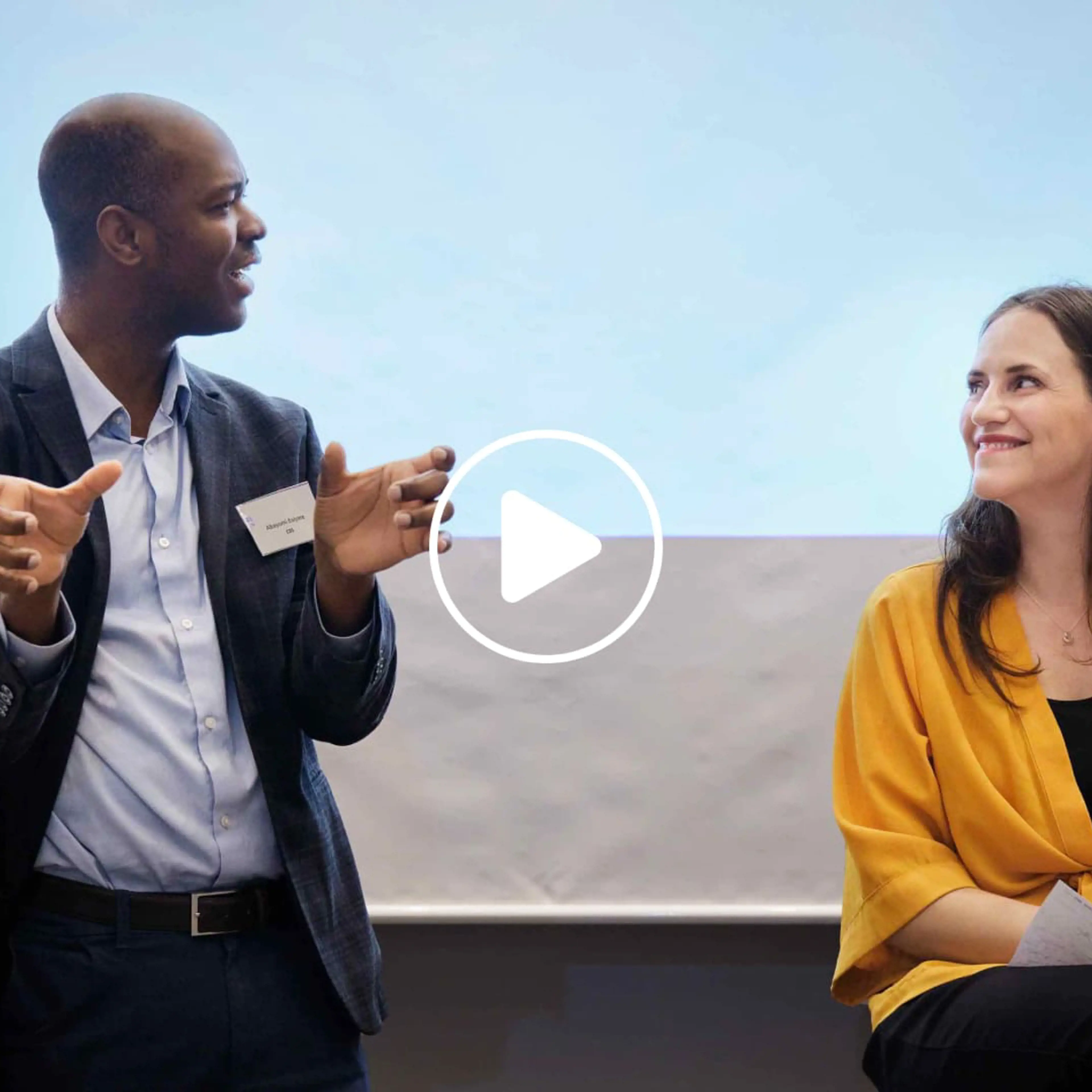
In this interview, CBS Professor Ioanna Constantiou and CBS Assistant Professor Sine Zambach talk about AI as a transformer in the workplace, and how professionals can work with AI as a sparring partner, task taker, or a hybrid.

In his research, Christian Hendriksen has identified three overarching approaches to AI. The first one involves delegating selected tasks to the technology – what he refers to as offloading. Here, the leadership task is to distinguish between tasks where the sender is of secondary importance and tasks where human presence is crucial.
“It rarely matters, who wrote the text on a website. But it does matter, who answers the phone in customer service,” he says.
The second approach focuses on using AI to improve the quality of decision-making. Here, humans remain accountable, while the technology is used as an analytical collaborator.
“In those situations, you don’t save time. You invest time to achieve a better decision basis,” says Christian Hendriksen.
The third and most far-reaching approach is hybrid work, where solutions are developed through close interaction between humans and AI, and where the boundary between contributions gradually becomes blurred.
“After extended interaction, it no longer makes sense to draw a sharp distinction between what is contributed by humans and what is contributed by AI,” he says.
Efficiency, but Only in the Short Term
Professor Ioanna Costantiou at CBS also researches AI, though her academic point of departure lies in digitalisation, data, decision-making and organisational change. Her focus is therefore on the structural and leadership implications of AI.
Ioanna Constantiou warns against organisations falling into the trap of viewing AI as just another tool designed to deliver short-term efficiency gains and rapid, measurable returns.
“AI is not just an investment. It is something far more complex. In the short term, automation can deliver efficiency, yes. But what happens in the long term? I worry about organisational sustainability – both public and private. If organisations fail, we all fail,” says Ioanna Costantiou.
Instead, she argues for a stronger focus on innovation, creativity and engagement. AI should be about organisational readiness and the emergence of new roles and architectures.
“AI emerges as a capability through the interaction between humans and algorithms. It is relational, evolving and unique to each organisation. If everyone uses generative AI solely for efficiency, they each lose their competitive advantage,” she says.
What should AI do and what should it definitely not do?

It is a misconception to believe that AI is something IT departments can manage on their own. AI places demands across the entire organisation.
“AI is not a tool, and AI is not just about technology. It is an organising capability that transforms how we do business. And it cannot be outsourced. This is a leadership issue that also involves executive management and boards. Everyone – including the CEO and the board – needs a basic understanding of AI,” says Ioanna Costantiou.
AI requires clear governance structures, accountability and clarity about who holds power over data, models and decisions. According to Ioanna Costantiou, reports show that up to 90 per cent of large organisations that introduce generative AI fail to achieve measurable returns. This creates a risk of layoffs based on flawed premises – and she suspects this is already happening to a significant extent.
“Last year, I learned that large organisations hire consultants to develop their AI strategies because top management needs to deliver something to the board. Consultants are very good at metrics and KPIs – but how do you set performance indicators for something as complex as AI?” she asks.
Ioanna Constantiou is not concerned that AI will eliminate all jobs. While AI will take over some tasks traditionally performed by humans, it will also create new roles.
“It is the interaction between people, data and technology that creates something unique. That is why future leadership will largely be about managing the symbiosis between humans and algorithms,” she says.
Christian Hendriksen emphasises that the largest investment in AI is rarely financial, but rather time. Organisations that seek to create long-term value with AI must allow room for experimentation, learning and adjustment, while at the same time establishing clear frameworks for responsibility and decision-making.
In this context, Hendriksen highlights a crucial question:
“Do we give employees the time and space to experiment? Do we allow mistakes and learning? Or do we prohibit use – knowing full well that many will use the technology anyway, but in hidden ways?”
He stresses that his point is not that all organisations should use AI.
“But everyone should be able to explain why they use it – or why they don’t. Because even if you never use AI, the technology will still change your strategic landscape in terms of competition, ways of working and expectations,” says Christian Hendriksen.
Christian Hendriksen is an Associate Professor at CBS. He has published the book "AI på Arbejde", alongside Sine Zambach and Mark Friis Hau, and is currently researching the use of Generative AI in organizations and supply chains. Christian is appointed to the CBS AI Board and is a widely used speaker on Generative AI use in practice.
Ioanna Constantiou is a Professor of Information Systems in the Department of Digitalization at the Copenhagen Business School. Her current research work focuses on the digital transformation of organisations and the impact of AI on strategy and leadership with focus on decision making and human-AI collaboration.



Did you find this content interesting? Sign up for our newsletter and gain access to more of our research findings and events.
With the world’s grand challenges awaiting us, we need to continuously evolve, gain new knowledge and insights, and upskill.
Dive into a world of knowledge by signing up below. You will get:
- Personal event invitations
- Pertinent research-based insights on business and society
- Information about the next intakes of our Executive Education programmes and courses

Gain insights into future technologies like artificial intelligence, blockchain, and quantum computing to future-proof your organisation and optimise business operations.

No matter your job title, it’s essential to have a solid understanding of digitalization and the opportunities and challenges technology brings. This course gives you exactly that.

CBS EMBA’s unique programme design and real-world applicability provides the platform for you to navigate a turbulent global business environment and become a leader in business who can steer your organisation to sustainable impact and success.